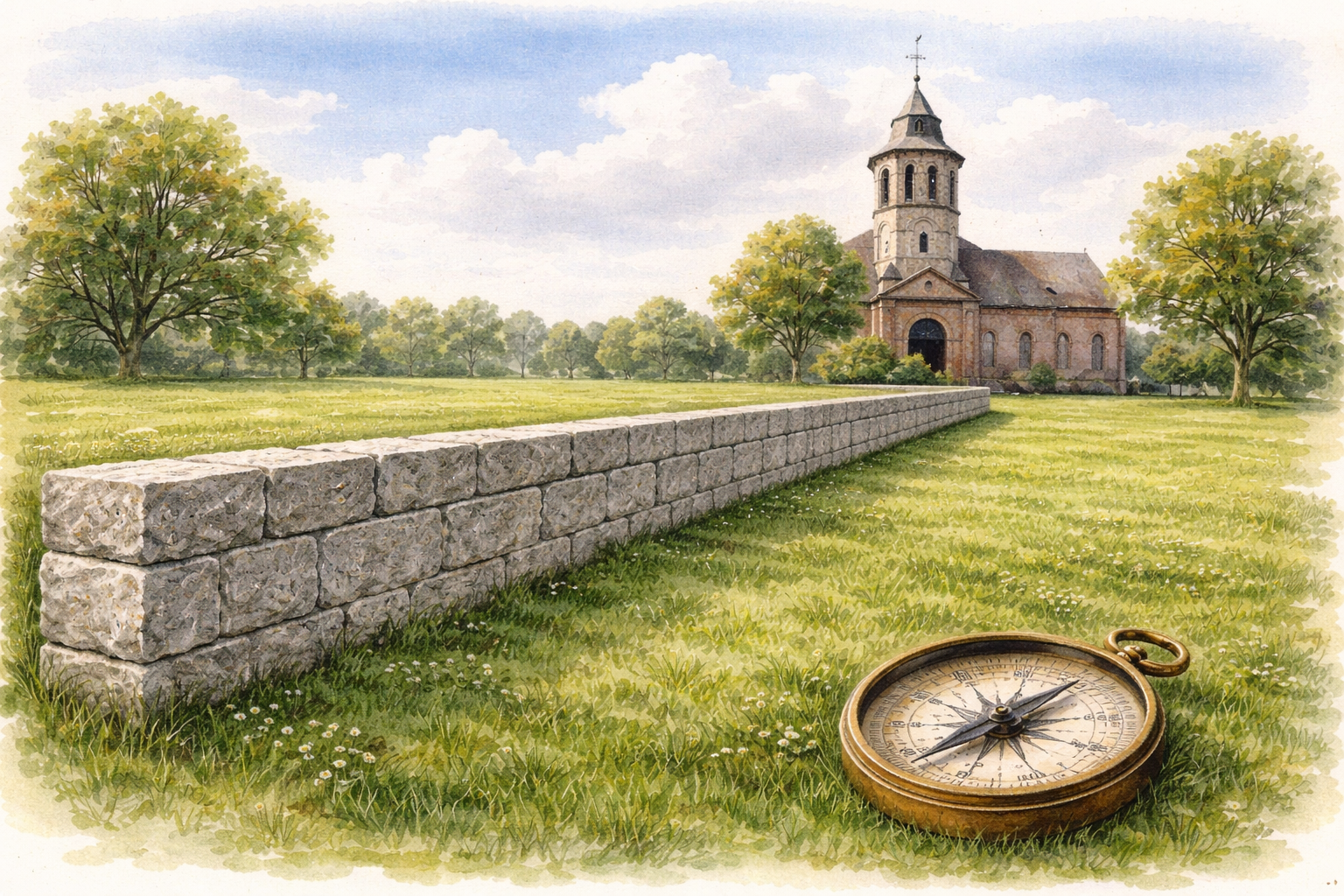
A memorial to the emigrants
The Go West monument symbolises the emigration of people from Adegem and Maldegem who left their homeland from the middle of the nineteenth century onwards to pursue the American Dream in the United States.
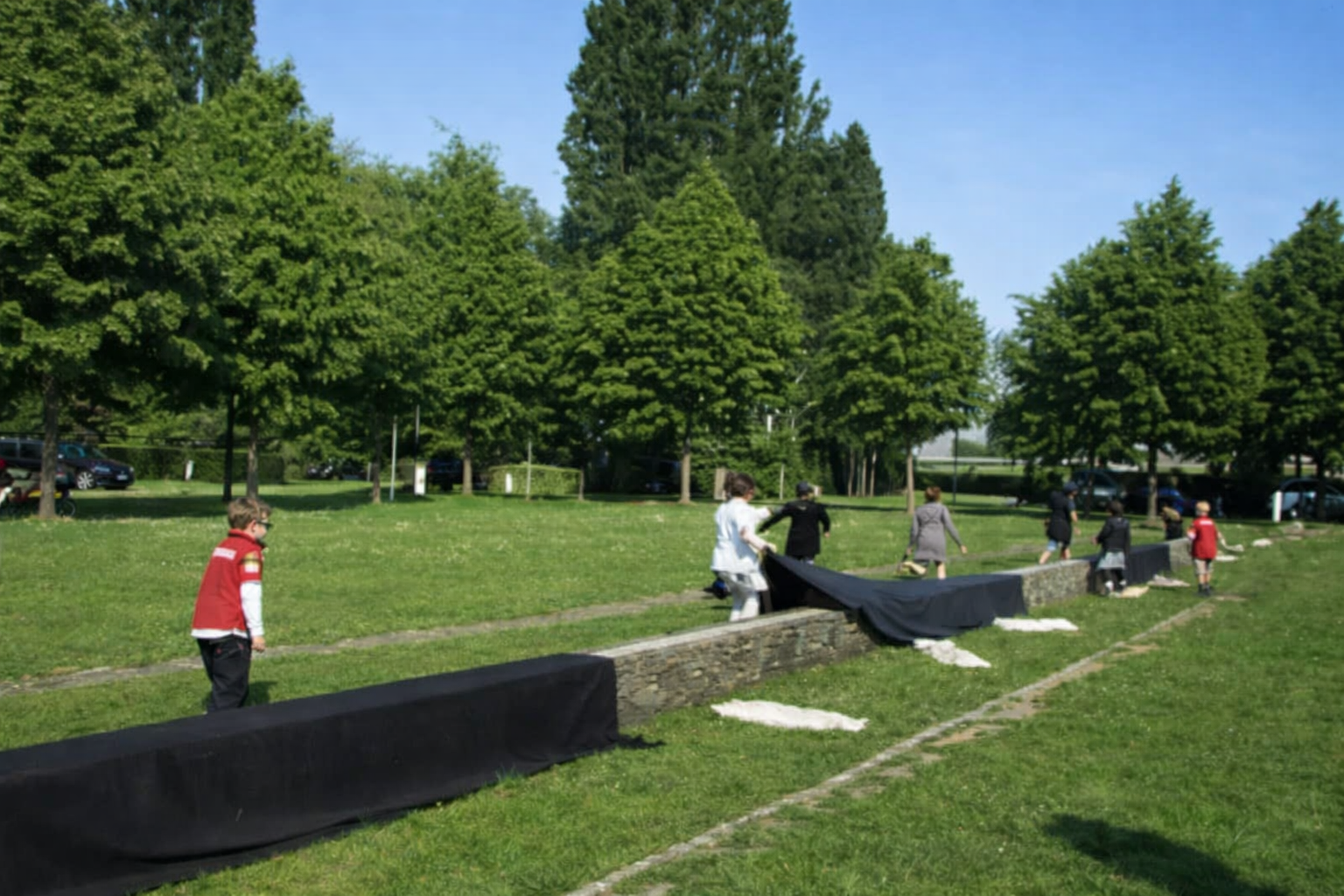
The concept of the artwork visualises the geographical distance and direction between Adegem and the city of Moline in Illinois, one of the most important destinations of Flemish emigrants. The exact distance between the two places is 6,385.82 kilometres. From Adegem, Moline lies at an angle of 290°21′ toward the northwest.
This distance is translated into a physical scale within the monument. A long concrete bench and light line stretch across the site, where every five millimetres represent one kilometre of the journey. To the east several rough, unfinished rock blocks lie scattered in the grass — symbols of hardship, poverty and the difficult starting point of many migrants.
From this point a narrow bench of 31.92 metres extends across the site in the direction of 290°21′ NW. The bench is made of concrete and decorated with vegetative motifs symbolising the course of life. At the western end young Canadian maples and American oak trees were planted, representing the new world and the hope of a new beginning.
During the day the monument functions as both a resting place and a memorial. At night the illuminated line becomes a beacon pointing westward. The triptych of rocks, bench and trees represents three moments in the life of a migrant: poverty, refuge and rebirth.
The long and narrow horizontal bench also resembles a balance beam, symbolising the uncompromising decision and the risky journey that every migrant had to undertake when leaving home in search of a better future.
In Adegem a small commemorative wall was built to honour all emigrants from Maldegem and Adegem who left for the New World during the nineteenth and early twentieth centuries. The direction of this wall symbolically points toward the west.
Emigration from Maldegem to the United States (1847–1924)
During many years of research into the Van Landschoot families of the United States, I repeatedly encountered the names of people originating from the Meetjesland. This observation deserved further research, with particular attention paid to the largely underexposed emigration from Maldegem.
This study focuses on the period between 1847 and 1924, during which roughly 1,400 inhabitants of Maldegem emigrated to the United States. The emphasis lies on the decades after 1892, when the great migration wave began. However, this does not mean that before 1847 no people from the region crossed the Atlantic.
For example, a certain Cornelius Langevelt, born in Sint-Laureins in 1628, already settled in New Amsterdam in 1654. Ten men from Maldegem served in the Dutch East India Company (VOC) during the first half of the eighteenth century and sailed to Batavia in the Dutch East Indies.
The earliest passenger manifests between 1847 and 1891 contain little information. Often they merely state “United States” as destination and rarely mention a specific place or even the emigrant’s home town in Belgium.
The first group of emigrants
The first emigrants from Maldegem belonged to a group of Meetjeslanders led by the young and ambitious lawyer Peter Dirckx from Eeklo.
In 1847 he corresponded extensively with the Belgian Ministry of Foreign Affairs to gather information about opportunities in the United States. On April 18 he announced his intention to emigrate with a group of people from Eeklo and surrounding villages.
Among the travelers were his brother-in-law Eduard de Grendell, Ambrose Van Landschoot, a father and son from Maldegem, Charles De Broeck from Watervliet, Pieter Van de Kerckhove, and Louis Lootens from Lembeke.
The passenger manifest of this journey has not yet been found. They probably arrived in Baltimore, Maryland, and travelled westward via the Ohio River to Jefferson, Missouri.
The group eventually settled in Taos, Missouri, a small community founded by the Flemish priest Helias D’Huddeghem from Ghent. Others later moved to St. Louis and to Moline in Illinois, which would become one of the main centres of Flemish settlement.
Further migration
During the following decades more families left Maldegem. The brothers Banckaert emigrated between 1854 and 1860. Ferdinand settled in Milwaukee, while Peter moved to South America.
The brothers Charles and Ambrosius Spelier arrived in Newark, New Jersey in 1866 after a journey of 45 days. Charles later settled in Kankakee, Illinois, while Ambrosius moved to Rock Valley, Iowa.
Another remarkable migration was that of Barbara Willems and her husband Joseph Fournier from Knokke. Together with their ten children they undertook the difficult two-month Atlantic crossing and eventually settled in Toledo, Ohio.
The Ellis Island period
After 1892 the situation changed dramatically with the opening of Ellis Island. Passenger lists now contained much more detailed information, including the address of relatives in America and the home address in Belgium.
From this moment onwards the number of emigrants from Maldegem increased rapidly. Many migrants travelled several times between Europe and America. For instance, Victor Van De Moere and his wife Philomena crossed the Atlantic six times between 1890 and 1932.
Main destinations
Illinois became by far the most important destination, especially the towns of Moline, Rock Island, Silvis and Milan. Henry County towns such as Atkinson, Geneseo and Cambridge also attracted many emigrants.
New York was the second major destination, particularly Rochester and the surrounding farming communities.
New Jersey ranked third, with many migrants settling in Paterson to work in the silk industry. St. Louis in Missouri became another important centre.
Other destinations included Minnesota, Michigan, Iowa, Indiana, North Dakota and Ohio.
Hans Van Landschoot with Pat (Van Landschoot) Barnes from Clearwater, Florida visiting the Go-West memorial in Adegem.
Sources
This research is based on data collected through numerous genealogical platforms and archives including FamilySearch, Ancestry, RootsWeb and other historical databases. Additional information was obtained from the Maldegem City Archives and VOC records.
Further information on Flemish emigrants can be found on the Meetjesland migration project, which documents about 3,500 emigrants from the region.