
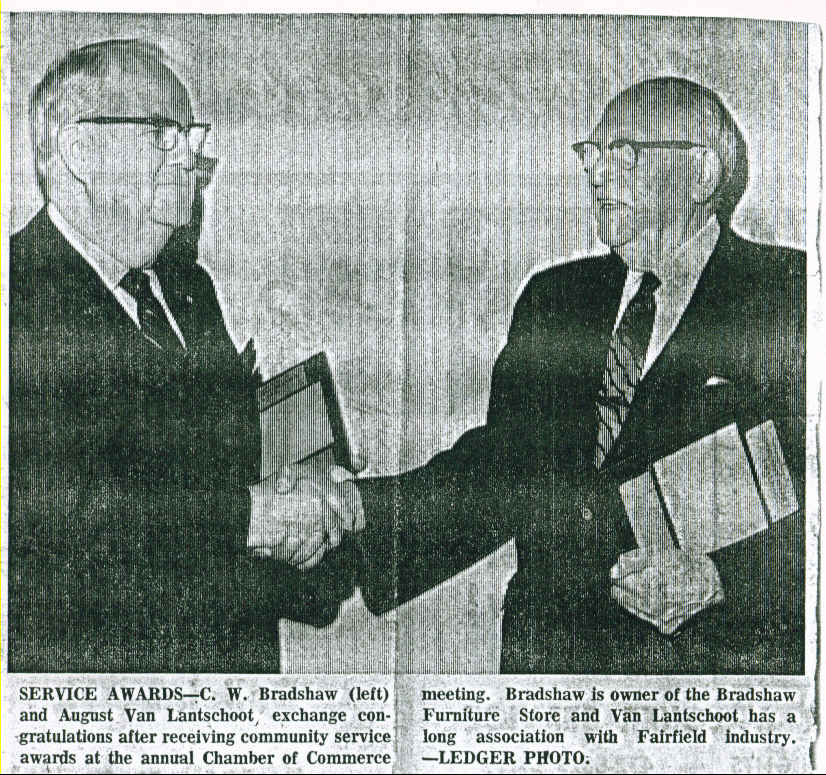
The life of August Van Lantschoot stands as one of those classic immigrant stories in which endurance, intelligence, and discipline gradually opened the way to achievement. He came to the United States as a young Belgian boy with only limited English, entered the foundry world at the lowest level, and over the years rose to become a metallurgist, superintendent, company founder, and respected civic figure in Fairfield, Iowa.
His story began in Bellem, near Aalter, in East Flanders. Born on November 28, 1889, he grew up in a Flemish landscape marked by work, religion, and the familiar horizon of village life. One remembered image from his youth remained with him for years: the sight from a windmill, looking out across the countryside of Belgium before departure for America. It was, by all accounts, the kind of farewell picture that would stay fixed in a young man’s mind for the rest of his life.
Arrival in America
On June 5, 1906, August Van Lantschoot arrived in the United States. Fairfield, Iowa, became the place where his American life would unfold. Like so many young immigrants, he entered a world that demanded physical endurance before it offered opportunity. He found work at the Iowa Malleable Iron Company, which at that time was still a relatively young industrial concern.
His first job was among the hardest imaginable: unloading railroad cars of coal. He was paid by the ton, and the labor was severe even for a strong young worker. Yet it was in this harsh environment that Van Lantschoot laid the foundation of his future. He knew only a few words of English, but he did not remain at that level for long. He taught himself the language through newspapers, books, and close attention to the technical world around him.
Learning the Trade from the Ground Up
After his earliest months of heavy labor, he moved into foundry work proper. He became first a “squeezer” and then a floor molder, steadily advancing through practical experience. His progress was not the result of chance. It came from patience, curiosity, and a willingness to absorb every aspect of the trade. Still a young man, he was soon entrusted with greater responsibilities, including work as a shipping clerk and later supervisory roles in production.
Van Lantschoot’s career developed along two tracks at once. On the one hand, he was gaining hard-earned knowledge on the foundry floor; on the other, he was educating himself in theory. This combination of practical skill and scientific curiosity distinguished him from many of his contemporaries. He became known not merely as a capable worker, but as a man who wanted to understand the deeper principles behind the craft.
Study and Specialization
In 1919, his talent was recognized in a decisive way. Walter V. Hughes of Iowa Malleable arranged for him to pursue advanced study in chemistry and metallurgy. This was a significant opportunity, and Van Lantschoot made full use of it. He attended the Malleable Iron Research Institute in Albany, New York, and also studied metallurgy at Rensselaer Polytechnic Institute in Troy, New York.
These studies gave structure to what experience had already begun to teach him. When he returned to Fairfield, he did so not merely as a seasoned workman, but as a trained metallurgical specialist. He became a metallurgist at Iowa Malleable and later assistant superintendent. By 1925, he had risen to the position of general superintendent of the plant.
Research, Innovation, and Technical Achievement
Van Lantschoot’s contribution to the foundry world went beyond plant administration. He took part in research on melting, annealing, and the improvement of malleable iron practice. He assisted in experimental work related to iron treatment and the development of stronger cast products. Reports also credited him with helping to improve methods that reduced brittleness in castings, a matter of real technical importance in industrial production.
He was part of that generation of foundry men who helped transform the trade from a largely empirical craft into a more scientific and disciplined field. His name became associated with industrial competence, technical seriousness, and a steady devotion to quality.
Founding Fairfield Aluminum Castings
After approximately forty years with Iowa Malleable, Van Lantschoot entered a new phase of life. In the mid-1940s he saw the growing promise of aluminum castings and founded the Fairfield Aluminum Castings Company. He became its first president, and under his leadership the firm developed into an important local manufacturer.
The company produced a broad range of castings for industrial and domestic use, including parts for washing machines, lawn mowers, parking meters, aircraft applications, poultry-raising equipment, and other machinery. Expansion followed. One report noted a large addition to the plant, increasing production space and reflecting the firm’s continued growth. At its height, the company employed around seventy workers and stood as a visible symbol of Van Lantschoot’s entrepreneurial vision.
Martha Van Lantschoot
No account of August Van Lantschoot is complete without Martha Van Lantschoot, his wife and long-time partner in industrial life. Martha was also Belgian by birth, a native of Nevele, and her own career in administration and bookkeeping closely paralleled that of her husband in production and metallurgy.
The two met within circles connected to Belgian immigrant life and the foundry world. Their shared background formed a natural bond, and their marriage created a partnership that extended far beyond private life. Martha worked for many years as a bookkeeper, first in related industrial employment and later for long periods in Fairfield itself. She eventually became treasurer and office manager of Fairfield Aluminum Castings, helping to shape the business side of the company that August had founded.
Contemporary newspaper pieces often emphasized that the couple’s careers almost ran in parallel. Together they formed a husband-and-wife team whose influence reached deeply into Fairfield’s industrial life for more than half a century.
Recognition and Public Esteem
Their long service did not go unnoticed. August and Martha Van Lantschoot were honored by the American Foundrymen’s Association with gold buttons marking fifty years of continuous service in the foundry industry. It was presented as an uncommon distinction and reflected the esteem in which they were held by their professional peers.
Another newspaper account marked an even later milestone: sixty years of activity in the foundry business. By then, August Van Lantschoot had already become a familiar and respected figure in Fairfield. He was described as still active, still engaged in daily work, and still associated with the company whose success embodied his life’s achievement.
Community and Character
August Van Lantschoot’s life extended beyond the factory walls. He was active in civic and fraternal circles, holding honorary or life memberships in several organizations, including the Elks Lodge, the Walton Club, the Eagles, and the Knights of Columbus. He was also a faithful member of St. Mary’s Catholic Church in Fairfield.
He was remembered as a man of broad interests. He enjoyed travel and spoke several languages, a fact that reflected both his European origins and his intellectual curiosity. In quieter moments he found pleasure in gardening, raising flowers and vegetables with the same care he had once given to industrial processes and technical detail.
Later Life
A later marriage announcement showed that his personal life also entered a new chapter after the death of Martha. Newspapers recorded his marriage to Mrs. Madeline R. Hammon, solemnized at St. Mary’s Catholic Church in Fairfield. Such notices remind us that beyond the public figure and industrial pioneer stood a man whose life also included companionship, loss, renewal, and the ordinary human rhythms that surround the long course of a career.
Legacy
August Van Lantschoot’s life belongs to the broader history of Belgian migration to the United States, but it also stands very much on its own. He was one of those immigrants who began with little, accepted the hardest labor, learned relentlessly, and rose step by step through intelligence and persistence. In him, one sees the transition from village Flanders to industrial America, from coal unloading to metallurgy, from employee to founder.
His biography is not merely a record of personal success. It also tells us something about the world that made such lives possible: the foundry towns of the American Midwest, the tight networks of Belgian immigrants, the role of self-education in upward mobility, and the strong thread of faith, work, and loyalty that marked so many of these families. In Fairfield, the name of August Van Lantschoot came to represent not only professional accomplishment, but endurance, seriousness, and a life fully built.