
Charles Albert Van Landschoot
Sailor of the United States Navy and Coast Guard during the Second World War, later a civil service operating engineer and resident of Las Vegas.
Charles Albert Van Landschoot was born on 1 August 1920 in Elgin, Illinois, at a time when the descendants of Belgian immigrant families had already become firmly rooted in the American Midwest. Like many Van Landschoot families in Illinois, his family belonged to that larger movement of Flemish emigrants and their descendants who had crossed the Atlantic in search of a new life.
Charles grew up in the wider area of West Chicago, in DuPage County, Illinois. Draft registration records show that his home address was RFD 2, Box 85, West Chicago, while his mother, listed as Mrs. R. Van Landschoot, was recorded as the person who would always know his address. These details, modest as they may seem, place him very precisely in the rural and small-town America of the interwar years.
Early service before Pearl Harbor
Charles entered military service on 12 May 1941, months before the attack on Pearl Harbor and before the United States officially entered the Second World War. This early enlistment is historically meaningful. It shows that he belonged to the group of young American servicemen who joined before the conflict had fully reached the United States, at a time when war in Europe was already reshaping the world.
During the war he served under service number 231-153. Surviving military paperwork also describes him physically: he stood 5 feet 10 inches tall, weighed about 154 pounds, had blue eyes, blond hair, and a ruddy complexion. Such details, preserved on registration records, bring a human dimension to the formal documents.
The USS Everett
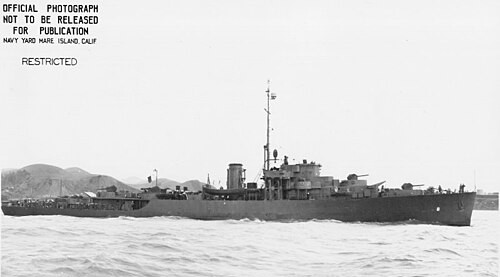
During the war Charles served aboard the USS Everett (PF-8), a patrol frigate of the United States Navy. Muster rolls show that he joined the crew on 22 January 1944, and he appears on the crew list dated 28 February 1944.
On that document he is listed as Boatswain's Mate Second Class, abbreviated B.M.2c. This was not a beginner’s role. A boatswain’s mate was responsible for the practical deck work of the ship: ropes, anchors, maintenance, manoeuvres, and supervision of other sailors during operations. It was a position that required discipline, reliability and practical seamanship.
Patrol frigates such as the USS Everett were important wartime vessels. They escorted convoys, guarded shipping lanes, and took part in anti-submarine warfare. Although they were smaller than battleships or aircraft carriers, they were indispensable in keeping Allied supply lines open. Serving on such a ship meant long periods at sea, repeated routine under pressure, and the constant reality of wartime danger.
From Navy service to Coast Guard discharge
The surviving records show that Charles’s wartime career also involved the United States Coast Guard, which during the war operated in close cooperation with the Navy. His registration file records that he was honorably discharged from the U.S. Coast Guard on 21 May 1946.
Only one week later, on 28 May 1946, he registered again with Selective Service. At that moment he was twenty-five years old and described as unemployed. His mailing address was given as 320 – 51st Street, care of Mrs. Irwin, Oakland, California, showing that he was in California during that transitional period just after the war.
These details suggest the unsettled but hopeful atmosphere of the immediate postwar years, when millions of former servicemen were returning to civilian life, moving between regions, looking for work, and rebuilding their futures after years of military duty.
Later life
In later years Charles was known by the nickname “Red”, a familiar and affectionate name that must have belonged to him in everyday life rather than in official military files. According to his obituary, he became a retired civil service operating engineer, a profession that points to practical skill, machinery, and steady technical work in civilian life.
By the final years of his life he had moved to Las Vegas, Clark County, Nevada, where he had been a resident for about two years. He died there on Wednesday, 25 September 2002, at the age of eighty-two.
His obituary, published in the Las Vegas Review-Journal on Sunday, 29 September 2002, remembered him as a World War II Coast Guard veteran and listed the family he left behind: his wife Lois; his son Warren of North Las Vegas; his daughters Charlene of San Antonio, Renee Belton of Las Vegas, and Diane Glass of North Las Vegas; as well as eleven grandchildren and eight great-grandchildren.
A life between immigration legacy and American service
The life of Charles Albert Van Landschoot belongs to a broader historical pattern. He was part of the second or later American-born generation of a family whose roots lay in Belgian migration, but his adulthood was shaped by the central events of twentieth-century American history: global war, military service, postwar mobility, technical civil work, and a final retirement in the American West.
In that sense his story is not only personal. It is also emblematic of many descendants of immigrant families in the Midwest. The surnames remained Flemish, the family memory remained partly European, yet the lives themselves became profoundly American — on farms, in towns, in uniform, and later across the expanding geography of the United States.
Charles Albert Van Landschoot’s surviving records allow us to follow him from Illinois to wartime naval service, from the USS Everett to Coast Guard discharge, and finally to Nevada. Together they form a clear and moving portrait of one member of the American Van Landschoot family during and after the Second World War.
Sources: U.S. military crew list of the USS Everett (PF-8); Selective Service registration card and registrar’s report; obituary notice for Charles A. “Red” Van Landschoot, The Las Vegas Review-Journal, Sunday, September 29, 2002.
Additional family information supplied by Irene Van Landschoot Wood of San Diego, California, with whom I had contact for several years until her death.