
 Nederlands
 Français
 Español
Cornelius Langhevelt — A Flemish Emigrant to New Netherland (1654)
A seventeenth-century pioneer from Saint-Laureins in the Meetjesland
During more than two decades of genealogical research into the families of the Meetjesland region of Flanders, unexpected discoveries occasionally open new windows onto the past. One such discovery concerns Cornelius Langhevelt, a man born in the small village of Saint-Laureins who would eventually become part of the early Dutch colony of New Netherland in North America.
For many years the earliest migration from the Meetjesland seemed to belong to the nineteenth century. Around 1845–1846 emigration from the region slowly began, and between 1845 and 1890 hundreds of inhabitants left for the United States. Research in parish registers and passenger lists has already identified about two hundred emigrants from this period. After 1892 millions of arrivals were recorded at Ellis Island, including thousands from the Meetjesland.
Yet the life of Cornelius Langhevelt shows that the connection between this Flemish region and North America reaches much further back in time. Already in the middle of the seventeenth century a young man from Saint-Laureins appears in the records of New Amsterdam, the city that would later become New York.
Origins in Saint-Laureins
Cornelius II Langhevelt was born on 23 July 1628 in Saint-Laureins in the Meetjesland region of Flanders. He was the son of Cornelius I Van Langevelde and Laurentia Van Assche. His baptismal sponsors were Herman Dobbelaer and Josina Mijnke.
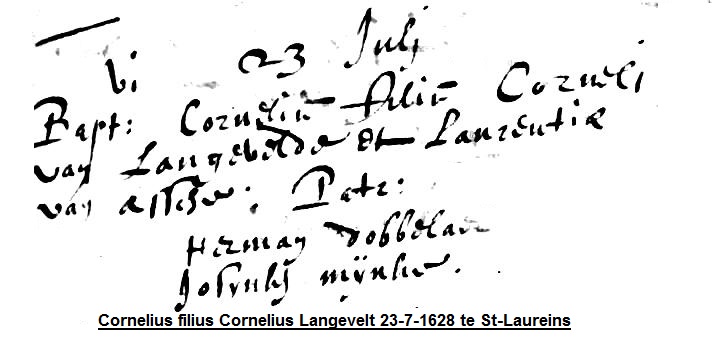
Two younger brothers were born in the same family: Adriaen in 1634 and Dionijs in 1636. Cornelius’ mother Laurentia died on 8 March 1637. Later that year his father remarried Anna Verheecke in Saint-Laureins.
Several individuals with the same surname appear in the parish registers during this period, suggesting a wider family network in the region. Judocus Van Langevelt and Jan Van Langevelt may have been brothers of Cornelius I. A Petrus Van Langhevelt who died in Saint-Laureins in 1666 at the age of eighty-eight may have belonged to the previous generation.
Departure for the New World
At some point between 1654 and 1655, Cornelius left Flanders and crossed the Atlantic Ocean to the Dutch colony of New Netherland. The voyage usually lasted between four and seven weeks depending on weather conditions.
By 1655 he appears in a tax list of craftsmen and traders living in New Amsterdam. In that year he paid eight guilders in taxes and was recorded as a trader in tobacco. In a voluntary contribution he also gave a beaver pelt and eight guilders.
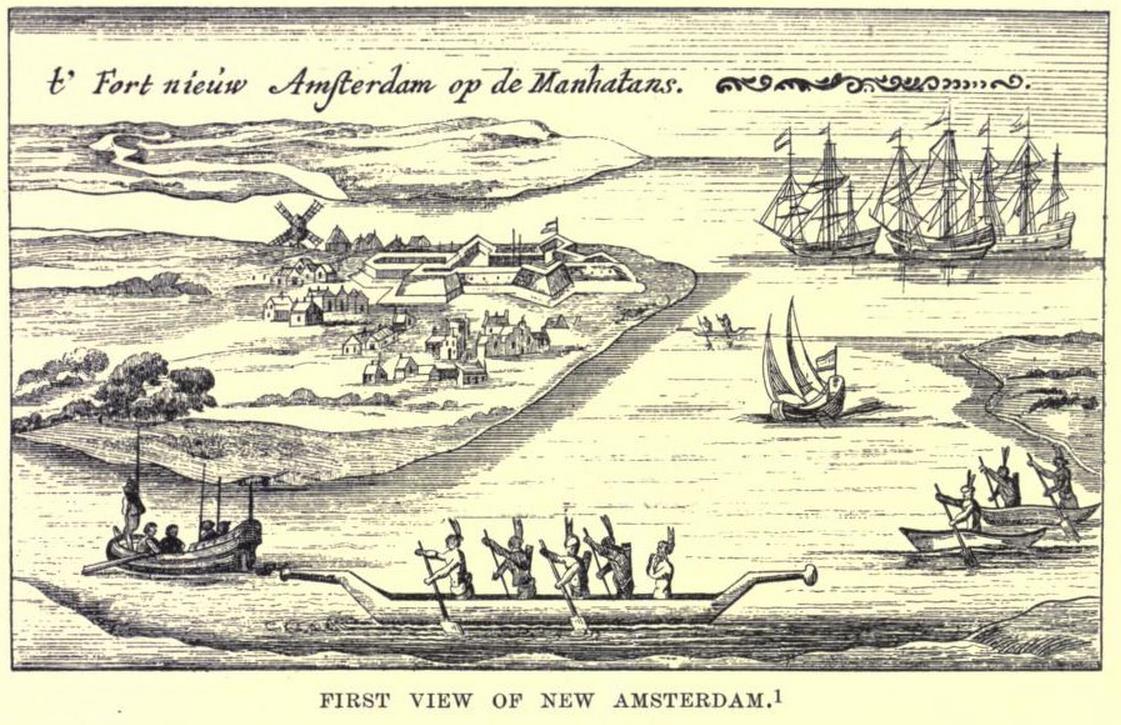
On 14 April 1657 Cornelius obtained the status of Small Burgher of New Amsterdam. This privilege allowed him to trade freely within the colony and provided access to certain guild privileges.
Marriage and Family
On 19 January 1658 Cornelius married Marritje Jans Jonkers in the Dutch Reformed Church of New Amsterdam. Records consistently state that he came from “St Laurens in Vlaenderen”.
Marritje had been born in New Amsterdam in 1639. Her father Jan Corneliszen Jonkers, originally from Rotterdam, had been killed by Native Americans in 1643.
The couple had three children:
- Cornelius III — born 1 December 1658
- Joannes — born 30 January 1661
- Aeltjie — born 14 February 1663
Shortly before the birth of their third child Cornelius II died. His widow Marritje remarried Thomas Laurenszn of Groningen on 6 June 1663.
Trade and River Transport
Between 1662 and 1664 Cornelius was among about forty boat owners operating transport between New Amsterdam and Beverwyck, today Albany. He owned a boat together with Albert Andries Bradt.
On 7 February 1663 Cornelius and his wife signed a legal document stating that the surviving spouse would inherit the household goods if the other died while their children were still minors. The document mentions jewellery and precious objects made of gold and silver.
A few days later Marritje, sick with smallpox and confined to bed after childbirth, dictated her testament before the notary Walewyn van der Veen in New Amsterdam.
The Longfield Descendants
Their eldest son Cornelius III later used the surname Longfield, an English version of Langevelt that appeared after the English takeover of New Netherland in 1674.
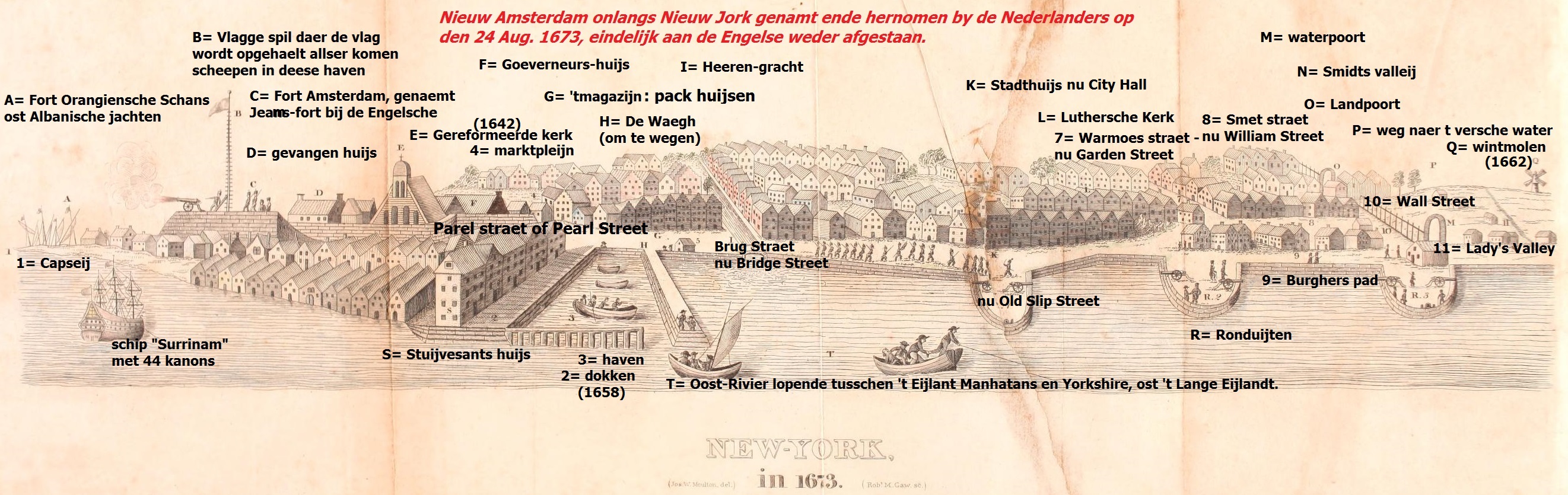
He married Maria Groenlandt in 1680. The family lived for some time in Pearl Street in New York, according to church lists compiled by the Dutch Reformed minister Henricus Seleyns.
Later Cornelius III settled in Piscataway in present-day New Jersey, where he became known as a trader with Native American communities. He owned land near the confluence of the Millstone River and the Raritan River and later played an important role in the development of New Brunswick.
He served as a member of the House of Representatives in 1690 and later as a member of the colonial assembly in 1696.
The surname Longfield eventually disappeared in the late eighteenth century, but many descendants continued through female lines and became prominent in New Jersey and Pennsylvania.
Sources
- Flemish Americans — http://flemishamerican.blogspot.be/search?q=maldegem
- Familiekunde Vlaanderen Meetjesland — http://www.familiekundevlaanderen-meetjesland.be
- Early History of Bedloe’s Island — http://www.cr.nps.gov/history/online_books/hh/11/hh11m.htm
- Manual of the Corporation of the City of New York — https://archive.org/stream/manualofcorporat1862newy#page/641/mode/1up
- Burghers of New Amsterdam — https://archive.org/stream/burghersnewamst00nygoog
- Journal of Jasper Danckaerts, 1679–1680
- Proceedings of the New Jersey Historical Society
- Provincial Councillors of Pennsylvania 1733–1776 — Charles P. Keith
- Minutes of the Orphanmasters of New Amsterdam, 1655–1663
- Records of New Amsterdam