
The Empress of Ireland — A Second Titanic in 1914
A transatlantic disaster on the St. Lawrence River, remembered in the Meetjesland through survivors and victims travelling between North America and Belgium.
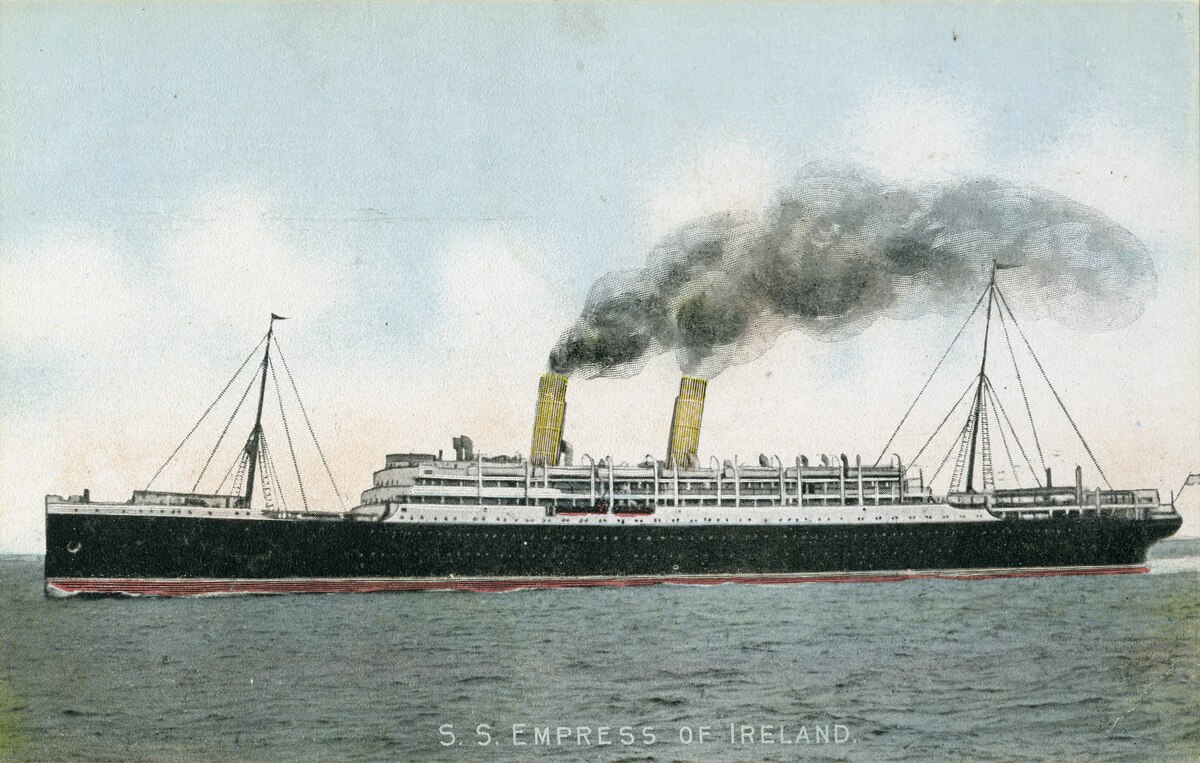
In the spring of 1914, newspapers in Belgium brought alarming and contradictory news. First came reports that a great passenger ship from Canada had sunk with hundreds dead. Then another message claimed that nobody had perished. But within a day the truth emerged: more than a thousand lives had been lost. After the Titanic, this was one of the greatest maritime disasters of the age.
The ship was the Empress of Ireland, outward bound from Quebec to Liverpool, moving down the St. Lawrence River in the early hours of 29 May 1914. In darkness and heavy uncertainty on the water, she was struck in her port side by the Norwegian coal ship Storstad. The damage was catastrophic. The wound was opened deep into the ship and within ten minutes the liner had sunk.
A catastrophe in minutes
The collision came so suddenly that many passengers were trapped in their cabins. First-class passengers sleeping near the point of impact were among the first victims. Lower down, in the second and third class sections, the loss of life was even worse. Many never had the chance to reach the deck.
Wireless operators sent out an urgent message immediately after the impact. Help was called from the shore near Father Point and Rimouski, but events unfolded too quickly. Unlike the long agony of the Titanic, the Empress of Ireland vanished almost at once. Lifeboats could hardly be launched; one side of the ship hung too high, the other too low, and there was scarcely time to react.
Belgian victims
As news spread, Belgian newspapers began to identify victims with ties to home. Among them was Father Godefroid, a missionary of Belgian origin travelling toward family in Mechelen. Even more tragic was the fate of the Verniers family.
Kamiel Verniers, originally from St-Niklaas, had emigrated to Montreal some five years earlier with his wife and children. He had recently written to his mother in Belgium that he intended to return with his family. But when relatives went looking for news in Antwerp, they discovered that the family had sailed on the Empress of Ireland. Kamiel, his wife and their six children were all lost.
Meetjesland and Moline
The disaster also touched the wider migrant world of the Meetjesland and the Belgian community in Moline, Illinois. Four men had boarded the ship together in Quebec: Victor Braet of Maldegem, Victor Van de Moere of Watervliet, Emiel Haertjens of Boekhoute, and Jacob Boone of Moerbeke-Waas.
They were travelling toward Europe, combining their return voyage with a pleasure trip through Canada. All four slept in the same third-class cabin. When the collision came in the night, two of them rose first to see what had happened. Those two did not return. The survivors later believed that Haertjens and Boone perished.
Victor Braet’s testimony
Victor Braet, about thirty years old and from Broekhuize near Maldegem, later gave a vivid account of the disaster. He had at first refused to leave his bed, but very soon he realized the danger was real. He dressed as best he could, took the money he had kept under his pillow, and remembered the life belt hanging above his head.
By the time he reached the stairway the lights had failed. He fell several times as the ship tilted sharply. On deck he saw hundreds of frightened people crying and shivering, but there was almost no time left. The ship rolled over, throwing passengers into the freezing water.
After drifting for perhaps twenty minutes, numb with cold, he managed to seize a small overloaded boat and then leap toward a larger one. He fell back once into the water, but by sheer strength he dragged himself aboard. From there he was eventually taken to the Storstad, the very vessel that had rammed the liner.
Victor Van de Moere
On board the rescue ship Braet discovered that Victor Van de Moere had also survived, though almost naked and in terrible condition. Van de Moere later told a similar story in the press of Moline. He described how he and Braet clung to the rail as the ship rolled over, then stood for a brief moment on what had become the nearly vertical side of the vessel before it slipped away beneath them.
Van de Moere lost his life belt and could not swim. Just as he was sinking, his hand struck a floating plank. He clung to it desperately and eventually managed to pull one knee over it, keeping himself alive until a rescue boat from the Storstad picked him up.
Braet later helped provide him with fresh clothes in Quebec. Braet himself soon returned to Europe, while Van de Moere, having lost all his money, went back to Moline to rebuild his means.
A disaster remembered in local memory
For the people of Maldegem, Watervliet, Boekhoute, Moerbeke and the wider emigrant network between Belgium and the United States, the loss of the Empress of Ireland was not an abstract world event. It was a deeply personal story, carried home through survivors’ accounts, family grief, newspaper reports and the shock of names suddenly recognized.
The tragedy linked many worlds at once: Quebec and Liverpool, Montreal and St-Niklaas, Moline and the Meetjesland. It remains one of the most dramatic examples of how migration history, local history and maritime disaster could intersect in a single night.
This story belongs to the wider world of Belgian migration and transatlantic travel. It is included here as an external historical story connected to the emigrant networks in which people from the Meetjesland and Moline moved in the early twentieth century.
Sources: Getrouwe Maldegem, 7 June 1914 and Getrouwe Maldegem, 14 June 1914, including the reports on the sinking of the Empress of Ireland, the Verniers family, and the survivor accounts of Victor Braet and Victor Van de Moere.